Priyanka Bansal Trump's India trip ignored the New Delhi riots. But his silence isn't the most damning.
As the bloodshed got worse, we heard not a word from the U.S. president. But he's not the only one staying oddly quiet despite the atrocities playing out before our eyes.
 President Donald Trump and Indian Prime Minister Narendra Modi arrive for a rally in Ahmedabad on Feb. 24, 2020.Alex Brandon / AP
Feb. 29, 2020, 6:15 AM AEDT
By Priyanka Bansal, freelance journalist
Throughout President Donald Trump’s first official visit to India, the photo opportunities were plentiful. Here, we have Trump and the first lady at the Taj Mahal. There, we have Ivanka Trump and Jared Kushner smiling in the Agra heat.
But there were other images coming out of India, too: Pictures and video of Indians being dragged along the ground by nationalists in New Delhi, pictures of gunshot wounds, bloodshed and fire. Several of Trump’s photo ops occurred just miles from the violent protests, where reportedly more than 40 people have died and hundreds more have been injured.
And in Gujarat, where Trump and Modi attended a massive rally together, a wall hastily constructed by the Indian governmentrepresented a dystopian albeit transparent effort to hide slums from America’s view.
Several of Trump’s photo ops occurred just miles from the violent protests, where reportedly more than 40 people have died and hundreds more have been injured.
As the violence raged on, we heard not a word from the president of the United States. But he is not the only one staying oddly silent despite the atrocities playing out literally before our eyes. Too many Indian American immigrants are also turning a blind eye to the domestic terrorism in India because they are uncomfortable with and ashamed of the realities of their country.
The violence was spurred by different perspectives: nationalists supporting the Citizenship Amendment Act (CAA), and anti-CAA protesters. The CAA was passed in December, granting a track to Indian citizenship for undocumented immigrants from Hindu, Sikh, Buddhist, Christian, Jain and Parsi backgrounds. The stated goal was to protect refugees coming from neighboring countries such as Pakistan, Bangladesh and Afghanistan. That is, refugees who are not Muslim. Muslim identities were conveniently left out of the amendment, but these three countries are Muslim majority nations. These same Muslim identities are also some of the most persecuted in the world, notably the Rohingya, who are fleeing to Bangladesh following ethnic cleansing in Myanmar.


Muslim shrine burned as deadly clashes mar Trump’s visit to IndiaFEB. 25, 202001:02
Indian Prime Minister Narendra Modi has not helped matters very much, brashly throwing around anti-Muslim rhetoric. From potentially gaslighting millions of citizens, assuring them of no religious bias, to revoking the special status of Jammu and Kashmir, another Muslim-majority state, Modi is clearly promoting a Hindu nationalist agenda. He, like Trump, is also the victor in an election campaign that has used fearmongering and anti-Muslim rhetoric to consolidate support.
Modi's and Trump’s kinship makes sense in this context. During a Houston rally in the fall, Modi said he supports Trump's efforts to "Make America Great Again." Trump and Modi pledged to support each other's efforts to “protect innocent civilians from radical Islamic terrorism.” From enacting a “Muslim ban” during his first days in office to speech that far too often denigrates minorities, Trump has encouraged the kind of anti-Muslim sentiment that dovetails with the Islamophobic atmosphere in India right now — and indeed is increasingly spreading around the world.
Related
 OPINION
Trump and India's Modi are two peas in a dangerous populist pod. Kashmir proves it.
The consequences of this atmosphere can be seen in the language used by Modi’s Bharatiya Janata Party (BJP), which threatens to denaturalize Muslims across the country. As Ravi Kishan, a prominent member of Parliament and supporter of the CAA, said recently, “India has always been a Hindu nation.”
As a first-generation, Indian American immigrant myself, I watch what is happening both in my home and the homes of many of my family members with frustration — and yet the Indian diaspora remains largely silent. Where is the outrage? I recognize the struggle and the fear of appearing “too American” or “too Westernized.” And I recognize the desire to want to connect with our homeland and its heritage. We, as immigrants, hold a double identity that we constantly battle to balance.
We dance around assimilation, being just Westernized enough, but not too much. Not so Westernized that onlookers are led to believe we have lost touch with our culture.

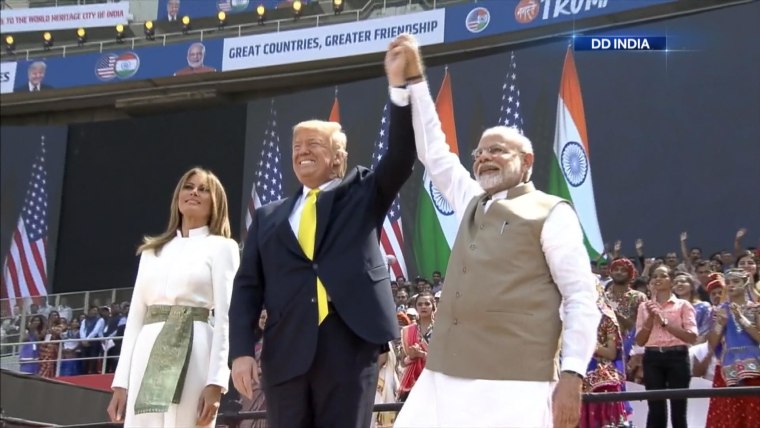
President Trump makes first visit to India, meets with PM ModiFEB. 25, 202001:50
So many of us want to believe in the best of our homeland and want to stay loyal to its values and traditions. But being ashamed of our country’s actions is not the same as being ashamed of our culture or heritage. Publicly denouncing Trump's and Modi’s actions do not equate to having “whitewashed,” Americanized views. Rather, it equates to believing in intersectional human rights. Modi is anti-Muslim. His actions, his words and his agenda show this.
And one of the reasons Modi is able to be so bold in his Islamophobia is because Trump — and all of us — are enabling him through our silence. Too often, post-colonial Eastern societies still place the West on a pedestal. This is apparent in the "king's welcome" that Trump received last week. Flags were hoisted, new plants potted, bodies of water refreshed, and performances scripted. India pulled out all the stops possible to impress Trump, including utilizing the largest cricket stadium in the world.
But those of us living in the West are privileged. And with that privilege comes the responsibility to speak up about the atrocities happening in India.
But those of us living in the West are privileged. And with that privilege comes the responsibility to speak up about the atrocities happening in India.
It is not right to support Modi simply out of a sense of Indian solidarity. We need to stand in solidarity with those working for the betterment of India. We must call out those who don’t dare decry Modi’s actions, those who are so easily seduced by Trump’s saccharine tweets in Hindi; tweets which ignore the crippling afflictions in India. We cannot let Trump’s deceptive techniques fool us into believing he has our interests at heart, as he has apparently fooled both Indians and Indian American immigrants alike.
Related
 OPINION
We want to hear what you THINK. Please submit a letter to the editor.
Indian American immigrants might rather avoid this messy topic. But we cannot settle for an authoritarian government — neither in America nor in India. We must confront the discomfort on social media and in WhatsApp chats. If we sit idly by, we are complicit.
The heart of India is burning. Pointing out the flaws is the only path toward a better India — an India we can all be proud of.
Priyanka Bansal
Priyanka Bansal is a Rutgers University student and a freelance journalist covering the South Asian community, mental health, and local New Jersey news.
