NRC possible even without CAA: Law, rules and notification already in place
The Rule 3 of the Citizenship (Registration of Citizens and Issue of National Identity Cards) Rules, 2003 deals with National Register of Indian Citizens (NRIC), or simply NRC. When read with the CAA-2003, the government already has the power to undertake the NRC exercise.

Prabhash K Dutta
March 2, 2020
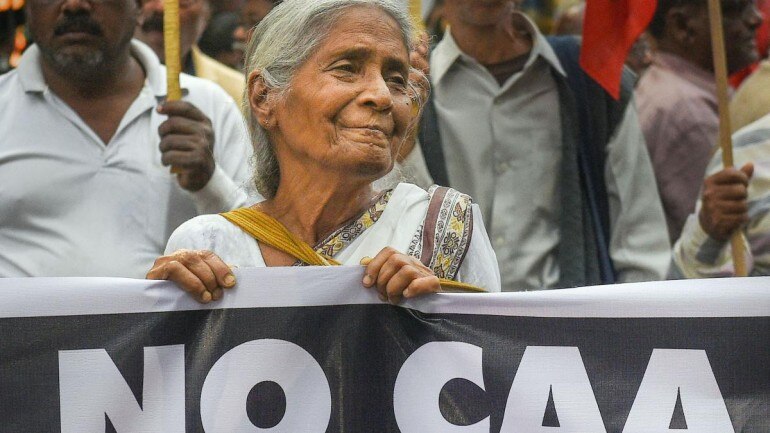
An elderly woman participating in an anti-CAA protest in Kolkata demanding rollback of the amendment to the Citizenship Act. (Photo: PTI)
Enactment of the Citizenship Amendment Act (CAA) in mid-December last year sparked off a polarising debate and a string of protests at several places across the country against the Narendra Modi government. While Shaheen Bagh, a protest site in Delhi, became the epicentre of Gandhian protest against the CAA, the increased polarisation on the issue led to communal riots in North East Delhi, where at least 46 people lost their lives over three days of clashes.
The primary demand of all those protesting against the Modi government has been the rollback of the Citizenship Amendment Act (CAA). They have also opposed the ongoing process to update the National Population Register (NPR) asserting that no documents should be shown to enumerators during door-to-door counting and verification of residing population with slogan of "kaaghaz nahin dikhaayenge".
In their third demand, the protesters sought clarification from the Modi government over preparation of the National Register of Citizens (NRC). Their most fundamental charge on the Modi government is that it is discriminating the Muslims against other communities to further its Hindutva agenda.
The government response on the three demands has been of refuting the charges leveled by the protesters with regard to alleged systemic discrimination against the Muslims, rejecting the demand for rolling back the CAA and climbing down on both the NPR and the NRC.
On NPR, the government did away with the necessity of "showing kaaghaz" while on the NRC, Prime Minister Narendra Modi declared at a public rally that the issue had not been discussed in the government. This came days after Union Home Minister Amit Shah told Parliament that a pan-India NRC would be implemented. In that sense, PM Modi politically overruled his home minister.
So, the basic question comes back to centre around the CAA. And, protests are still going with protesters linking it with the NRC. The government, on its part, continues to deny the link. While the CAA and anti-CAA protests hog the limelight and stay in focus, the fact is, the government does not need a new law, fresh set of rules or even a new notification to carry out the NRC exercise.
This means that even if the government accepts the demand of anti-CAA protests of withdrawing the amendment to the Citizenship Act 1955, it can still go ahead and prepare an NRC.
Originally, the NRC came up as a concrete concept in 1951 but it was limited to Assam only as the issue of illegal immigrants was a raging one in the state even before the country attained Independence.
On a national scale, the NRC became a legal currency in 2003-04 when the then Atal Bihari Vajpayee government enacted the CAA-2003 and notified its rules. The Citizenship Amendment Act of 2003 and more importantly relevant the Citizenship (Registration of Citizens and Issue of National Identity Cards) Rules, 2003 can be accessed here and here respectively.
To top it up, the Modi government issued a notification - SO 2753(E) - on July 31 last year that completes the legal framework for updating the NPR in 2020. It says, "In pursuance of sub-rule(4) of rule 3 of the Citizenship (Registration of Citizens and Issue of National Identity Cards) Rules, 2003, the Central Government hereby decides to prepare and update the Population Register and the field work for house to house enumeration throughout the country except Assam for collection of information relating to all persons who are usually residing within the jurisdiction of Local Registrar shall be undertaken between the 1st day of April, 2020 to 30th September, 2020."
The Rule 3 of the Citizenship (Registration of Citizens and Issue of National Identity Cards) Rules, 2003 deals with National Register of Indian Citizens (NRIC), or simply NRC. When read with the CAA-2003, the government already has the power to undertake the NRC exercise.
What CAA of 2019 offers is purely this: Filter some groups of illegal immigrants making them eligible for faster naturalization. For the rest of illegal immigrants - including Muslims from Bangladesh, Pakistan and Afghanistan against whom the CAA is targeted -- the option of naturalization holds valid but without any expediting provision.
Simply put the CAA rollback, if at all happens, may only be a major retreat by the Modi government against protesters sitting-in at Shaheen Bagh and elsewhere, but it may not actually help those in whose name the protests have continued for about 100 days.
An elderly woman participating in an anti-CAA protest in Kolkata demanding rollback of the amendment to the Citizenship Act. (Photo: PTI)
Enactment of the Citizenship Amendment Act (CAA) in mid-December last year sparked off a polarising debate and a string of protests at several places across the country against the Narendra Modi government. While Shaheen Bagh, a protest site in Delhi, became the epicentre of Gandhian protest against the CAA, the increased polarisation on the issue led to communal riots in North East Delhi, where at least 46 people lost their lives over three days of clashes.
The primary demand of all those protesting against the Modi government has been the rollback of the Citizenship Amendment Act (CAA). They have also opposed the ongoing process to update the National Population Register (NPR) asserting that no documents should be shown to enumerators during door-to-door counting and verification of residing population with slogan of "kaaghaz nahin dikhaayenge".
In their third demand, the protesters sought clarification from the Modi government over preparation of the National Register of Citizens (NRC). Their most fundamental charge on the Modi government is that it is discriminating the Muslims against other communities to further its Hindutva agenda.
The government response on the three demands has been of refuting the charges leveled by the protesters with regard to alleged systemic discrimination against the Muslims, rejecting the demand for rolling back the CAA and climbing down on both the NPR and the NRC.
On NPR, the government did away with the necessity of "showing kaaghaz" while on the NRC, Prime Minister Narendra Modi declared at a public rally that the issue had not been discussed in the government. This came days after Union Home Minister Amit Shah told Parliament that a pan-India NRC would be implemented. In that sense, PM Modi politically overruled his home minister.
So, the basic question comes back to centre around the CAA. And, protests are still going with protesters linking it with the NRC. The government, on its part, continues to deny the link. While the CAA and anti-CAA protests hog the limelight and stay in focus, the fact is, the government does not need a new law, fresh set of rules or even a new notification to carry out the NRC exercise.
This means that even if the government accepts the demand of anti-CAA protests of withdrawing the amendment to the Citizenship Act 1955, it can still go ahead and prepare an NRC.
Originally, the NRC came up as a concrete concept in 1951 but it was limited to Assam only as the issue of illegal immigrants was a raging one in the state even before the country attained Independence.
On a national scale, the NRC became a legal currency in 2003-04 when the then Atal Bihari Vajpayee government enacted the CAA-2003 and notified its rules. The Citizenship Amendment Act of 2003 and more importantly relevant the Citizenship (Registration of Citizens and Issue of National Identity Cards) Rules, 2003 can be accessed here and here respectively.
To top it up, the Modi government issued a notification - SO 2753(E) - on July 31 last year that completes the legal framework for updating the NPR in 2020. It says, "In pursuance of sub-rule(4) of rule 3 of the Citizenship (Registration of Citizens and Issue of National Identity Cards) Rules, 2003, the Central Government hereby decides to prepare and update the Population Register and the field work for house to house enumeration throughout the country except Assam for collection of information relating to all persons who are usually residing within the jurisdiction of Local Registrar shall be undertaken between the 1st day of April, 2020 to 30th September, 2020."
The Rule 3 of the Citizenship (Registration of Citizens and Issue of National Identity Cards) Rules, 2003 deals with National Register of Indian Citizens (NRIC), or simply NRC. When read with the CAA-2003, the government already has the power to undertake the NRC exercise.
What CAA of 2019 offers is purely this: Filter some groups of illegal immigrants making them eligible for faster naturalization. For the rest of illegal immigrants - including Muslims from Bangladesh, Pakistan and Afghanistan against whom the CAA is targeted -- the option of naturalization holds valid but without any expediting provision.
Simply put the CAA rollback, if at all happens, may only be a major retreat by the Modi government against protesters sitting-in at Shaheen Bagh and elsewhere, but it may not actually help those in whose name the protests have continued for about 100 days.
Read | Votes and the CAA
Also read |
You may like it | CAA, NPR and NRC: Confusion and connection explained
