India defends CAA after UN rights chief approaches Supreme Court
UN Commissioner for Human Rights files application with Indian top court to join plea challenging the controversial law.
by Bilal Kuchay
19 hours ago
 UNHRC chief Michelle Bachelet informed India of its application to be a third party in a petition brought by a former civil servant [Denis Balibouse/Reuters]
MORE ON INDIA
India defends CAA after UN rights chief approaches Supreme Courttoday
'Gov't killed my husband': Why are detainees dying in Assam?yesterday
New Delhi, India - India has defended its controversial Citizenship Amendment Act (CAA) as an internal issue after the United Nations rights body approached the country's top court challenging the legislation.
On Monday, UN Commissioner for Human Rights (UNHRC) Michelle Bachelet informed India that her office has filed an application urging the Supreme Court to make the UN body a third party in a petition filed by a former civil servant against the law.
More:
Thousands protest in US cities against India citizenship law
How India uses colonial-era sedition law against CAA protesters
Indian protesters hold interfaith prayers at Shaheen Bagh
"Our permanent mission in Geneva was informed yesterday [Monday] evening by the UN High Commissioner for Human Rights that her office had filed an intervention application in the Supreme Court of India in respect to the 2019 CAA," India's Ministry of External Affairs spokesman Raveesh Kumar said in a statement on Tuesday.
"The CAA is an internal matter of India and concerns the sovereign right of the Indian Parliament to make laws. We strongly believe that no foreign party has any locus standi [rights] on issues pertaining to India's sovereignty," said Kumar.
The CAA makes it easier for religious minorities from three neighbouring Muslim-majority countries who came to India before 2015 to get Indian citizenship - but not if they are Muslim.
Coupled with the ongoing National Population Register (NPR) and a proposed National Register of Citizens (NRC), India's Muslims, who form nearly 15 percent of the country's 1.3 billion population, fear the steps are aimed at marginalising them.
Nearly 140 petitions have been filed by Muslim groups, opposition parties and activists, who say the law violates India's secular constitution. The Supreme Court is due to hear the pleas next week.
Academic and legal expert Faizan Mustafa told Al Jazeera the Supreme Court may end up hearing the UNHRC application.
"As a UN member, we are bound by our pledge under Article 56 of the UN charter to uphold fundamental freedoms of all people. We cannot discriminate on the basis of religion," he said, adding that the UNHRC move may "damage India's reputation".

Javad Zarif
✔@JZarif
Iran condemns the wave of organized violence against Indian Muslims.
For centuries, Iran has been a friend of India. We urge Indian authorities to ensure the wellbeing of ALL Indians & not let senseless thuggery prevail.
Path forward lies in peaceful dialogue and rule of law.
The UNHRC application also came as India on Tuesday summoned the Iranian envoy in New Delhi over tweets by Iran's Foreign Minister, Mohammad Javad Zarif, condemning the "wave of organised violence against Indian Muslims".
Kumar said a "strong protest was lodged against the unwarranted remarks" by Tehran, adding that they were "not acceptable".
Delhi sees worst religious violence in decades
UN application after Delhi violence
Since the passage of the CAA on December 11, hundreds of thousands of people across India, led mainly by Muslims and students, have been protesting against the legislation.
So far, the violence against the law has killed more than 75 people across the country.
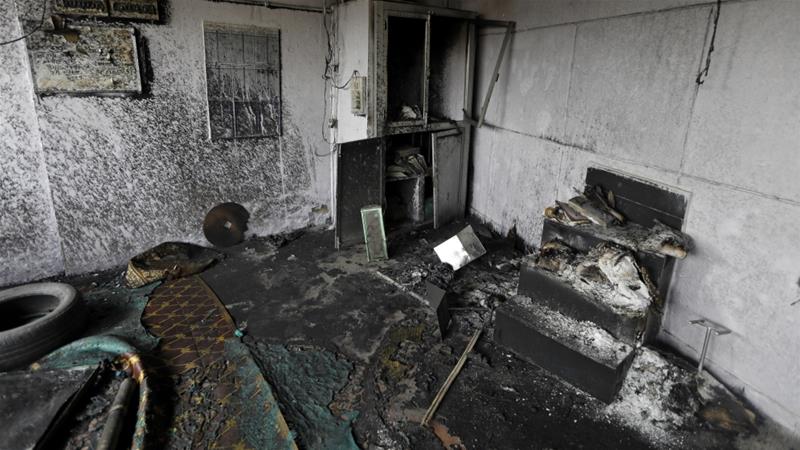
Last week, in the worst communal violence in decades in the national capital, at least 47 people were killed and more than a 100 wounded as groups chanting Hindu nationalist slogans torched mosques and dozens of Muslim houses.
Many Muslims abandoned their homes in the areas hit by the violence and took refuge in shelters set up by voluntary relief workers or moved to their relatives' houses.
The violence took place after a series of hate speeches were made by the ruling Bharatiya Janata Party (BJP) leaders, some of whom warned Muslims to wind down peaceful sit-ins or face consequences.
Videos shared on social media showed Delhi Police officials forcing injured Muslim men to sing the national anthem, and in some cases, smashing CCTV cameras in violence-affected areas.
Unfazed by criticism, India's Hindu nationalist Prime Minister Narendra Modi last month said his government stands by its CAA decision "despite all the pressure".
INSIDE STORY
Can religious violence in India be contained?
SOURCE: AL JAZEERA NEWS
